.svg)
Forbidden Sight
Created a 3D Co-op Survival Horror game 6 months in development in a team of 7 people.
Date: January 2026 (Demo on Steam, full game in development)
Role: System & Technical Game Designer, Marketer
Skills: Unreal Engine 5, Blueprint visual scripting, C++, Diversion Version Control, Trello, Scrum
Contribution:
-
Collaborated with Content Designer to design the light gun, enemy AI, and puzzle mechanics
-
Designed and implemented a puzzle solver system that automates puzzle logic and triggers door interactions upon completion
-
Collaborated with Network Engineer to design and implement networked puzzle elements using Blueprints and C++, ensuring consistent multiplayer puzzle states
-
Prototyped a modular puzzle system in Blueprints, enabling level designers to easily reuse and customize it
-
Managed builds and version control as the project’s build master
-
Scheduled publisher meetings with Marketing Lead and advertised our game in events
Creation of Light Gun Gameplay
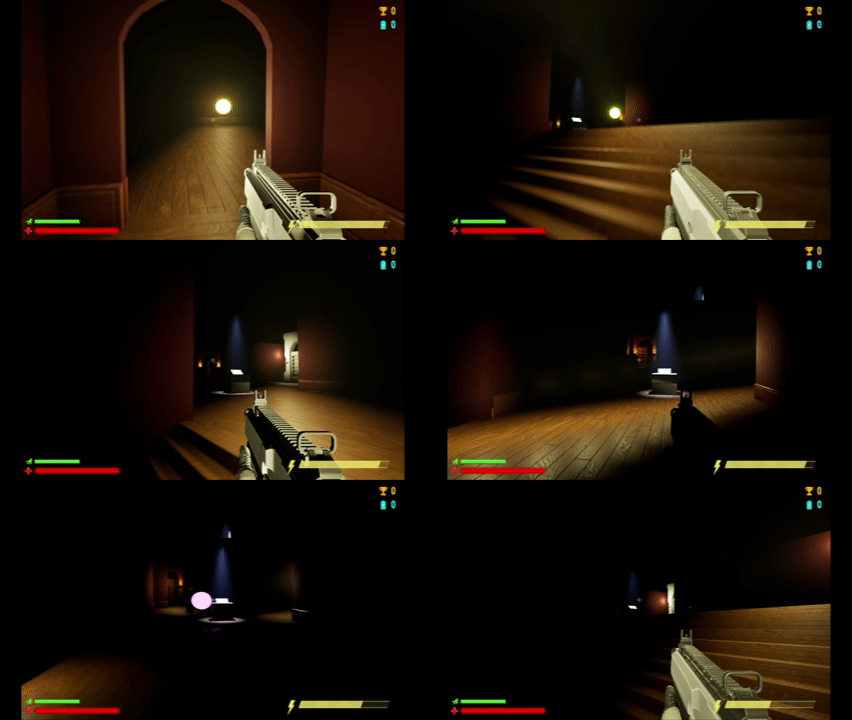
- The game feel I wanted to achieve was to create tension and encourage players to make strategic choices when shooting bullets.
- To achieve this, we created 3 types of light guns that share ammo count/battery. With each gun type spending different amount of ammo, players are forced to make decisions to manage the gun battery at every moment when they explore.
- The Gamma gun, which destroys light and damages enemies, are designed to cost more battery to encourage players to avoid the enemies rather than fighting them.
Creation of Light-Activated Enemy
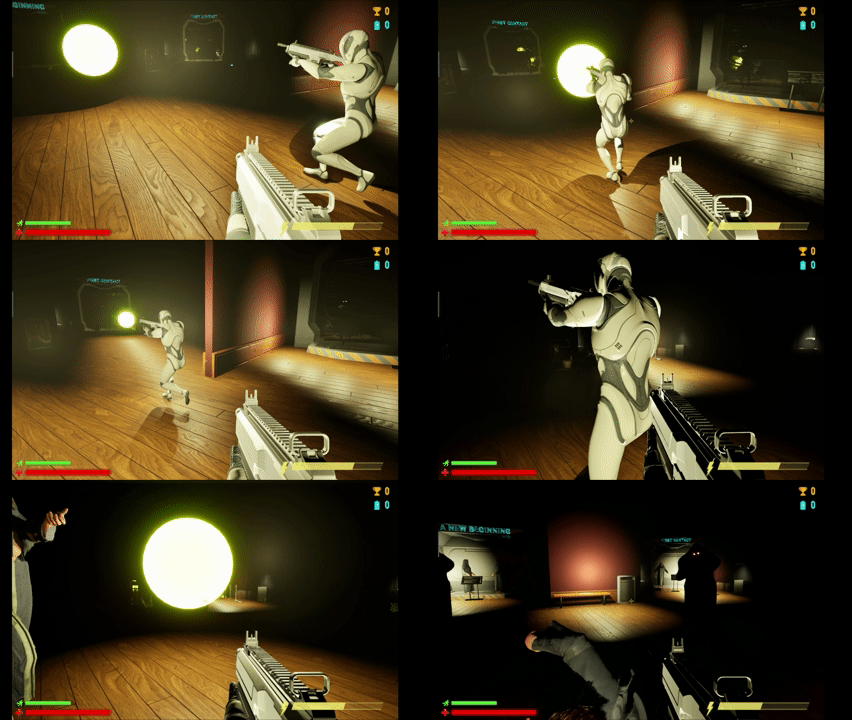
- We designed enemy AI inspired by the “Weeping Angels” concept, where wax figure enemies slowly approach players when unnoticed. However, it felt overused to use the mechanic as it is.
- To make encounters more interactive and strategic, our enemies start deactivated and are become activated for a period of time when illuminated by the Light Illumination Gun, indicated by red, glow-in-the-dark eyes. Once activated, they pursue players who are in line of sight and inside the light trail left by the gun.
- To encourage stealth over combat, I plan to balance the AI by increasing enemy health and decreasing speed, creating tension while promoting strategic gameplay.
Balancing Light with Darkness
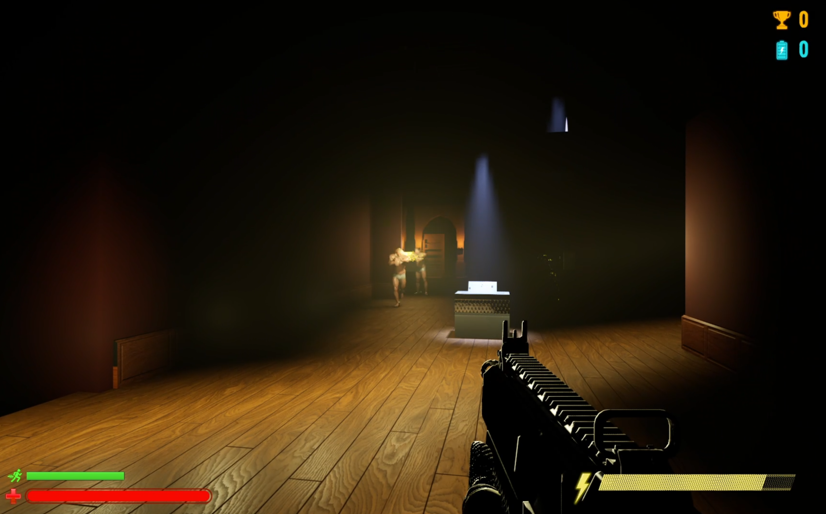
- Players need to shoot the Light Illuminator Gun to explore the map and advance forward, but doing so puts them under risk of attracting enemies. To create a mechanic that counterbalances this, we added the second gun, the Gamma Gun.
- The Gamma Gun, which damages enemies and destroys light in its path, allows users to create a safe space after they have lit up the path to observe the area around them. We wanted to create the irony where players are safer when they are surrounded by the darkness.
Balancing
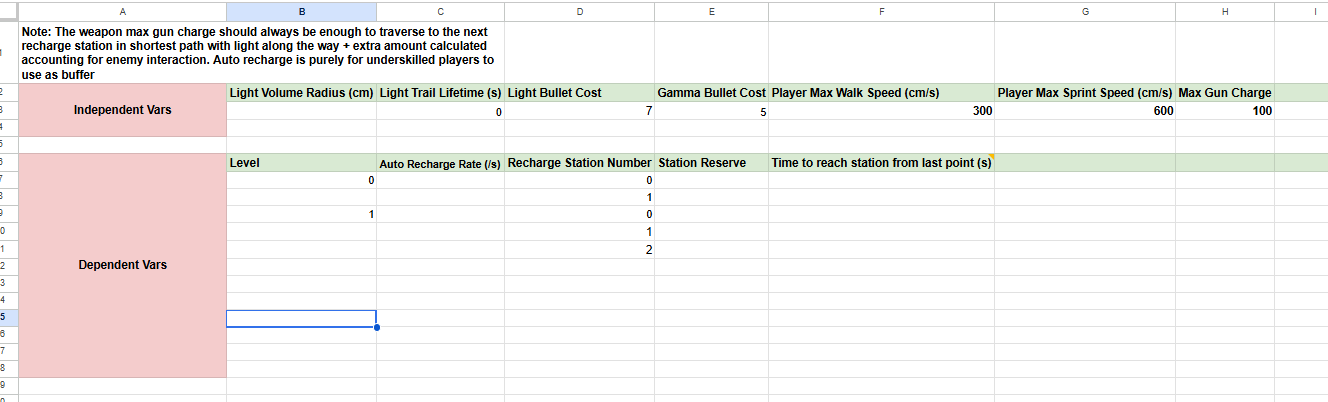
- Since the game uses Light Charge as central resource, I wanted to create a master balance sheet that calculates required Light Charge Reserve for each Charging Station.
- The ideal balancing would give enough light charge to Charging Station to allow players to reach the next charging station without needing to rely on the auto light recharge with some buffer taken into account for enemy interaction. Auto recharge should mostly be for underskilled players to use as buffer, as waiting builds frustration.
Weight-Detecting Pressure Plates
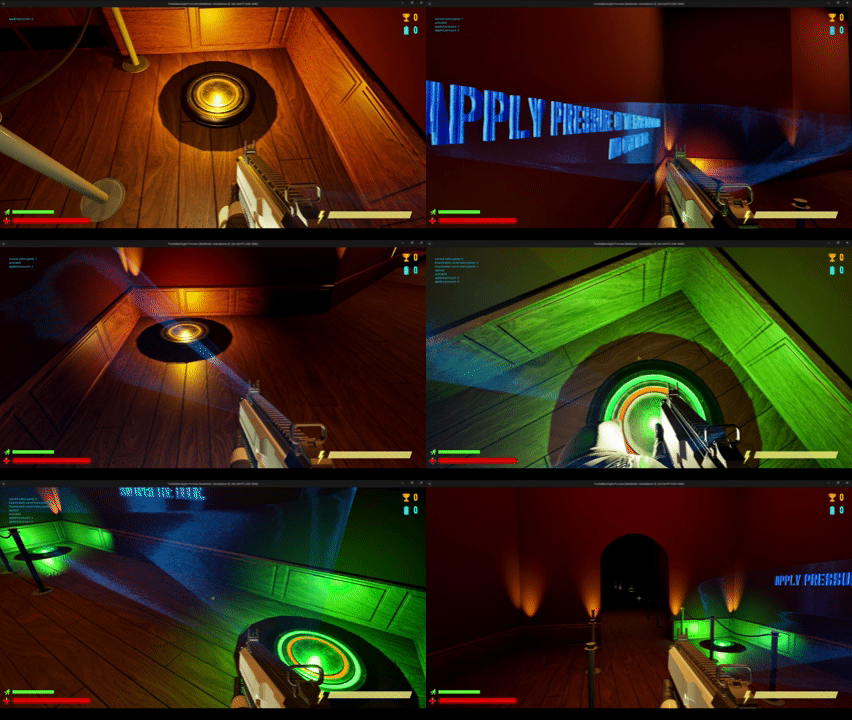
- Inspired by Genshin Impact, I designed pressure plates that reacts to a bullet hit, a player standing on top, or an enemy standing on top.
- The pressure plates also have 2 kinds: permanent and temporary. Permanent plates stay activated after its initial activation, while temporary plates are only activated when the weight is applied to them.
- In our game, they are used to unlock doors and give access to new areas to players.
Light Turrets & Batteries
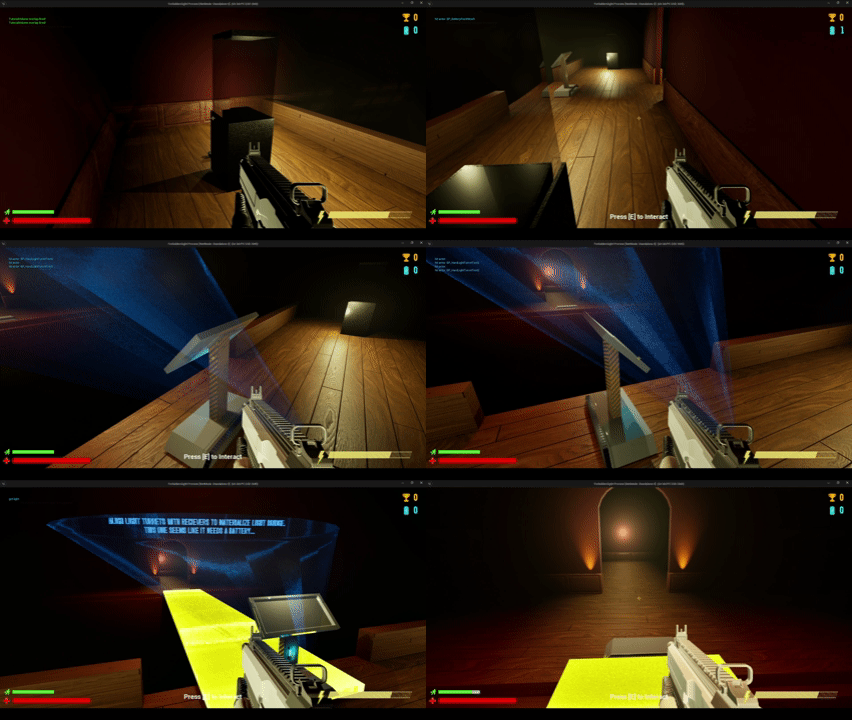
- I designed a light turret, receiver, and battery that interact to create a light bridge which allows player non-traditional traversal in the map.
- Players are able to pick up and insert batteries in light turrets to activate them. They can then rotate the turrets to align them with the receiver, which will create a light bridge between them.
Charging Station
- Players can put their gun at the charging station to charge it. They are unable to use their guns during the charging.
- The charging station has a maximum reserve limit that is shared among players in multiplayer, which allows for strategic resource distribution between players, or in some cases, trolling.
Random Battery Spawner
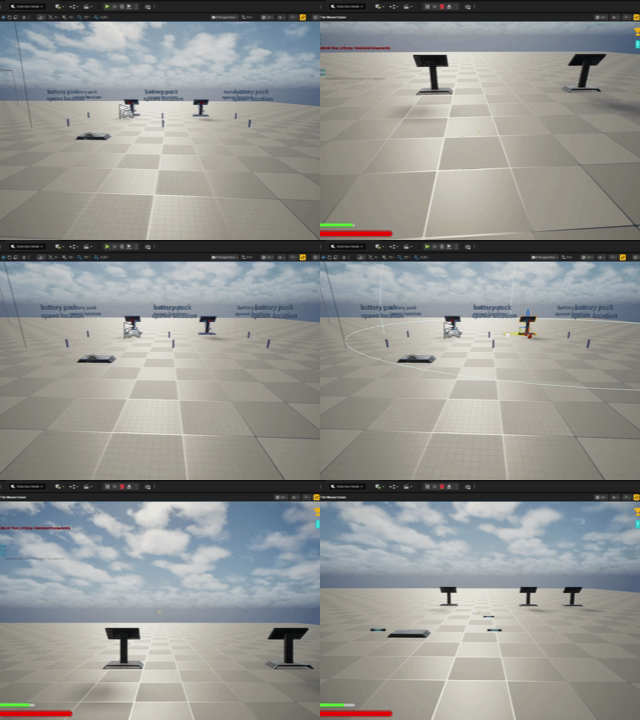
- Since our game had strong puzzle elements in its gameplay, replayability was one of our biggest concerns during pre-production. Randomized spawning of batteries, one of the resources players need to activate Light Turrets, was one of the solutions we came up for this problem.
- I built a Battery Spawner and Battery Spawn Manager that automatically counts the required batteries in a level and randomly spawns them between the Battery Spawners that level designers can use.
Pressure Plate Manager Volume
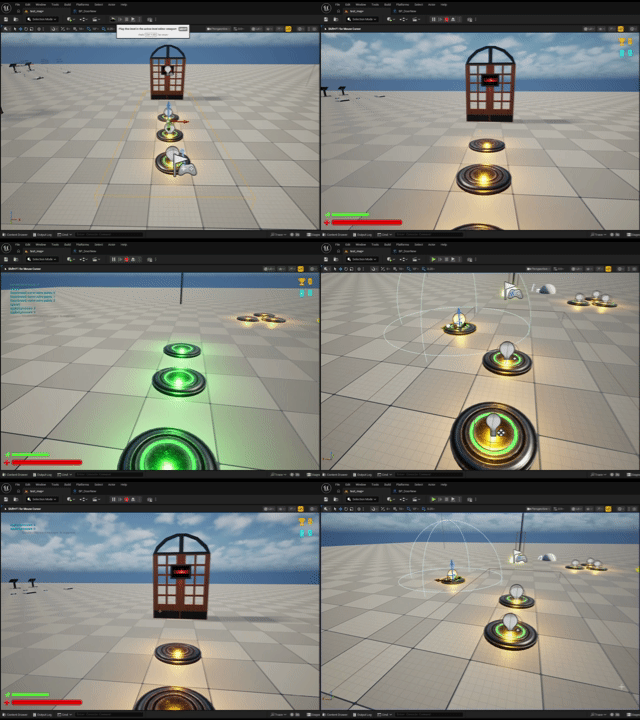
- I built a Pressure Plate Manager Volume for level designers that automatically manages the activation status of the pressure plates in the volume and opens all the doors in the volume when all plates are activated.
- Level designers also have an option to toggle if they want the door to stay open after initial opening or only stay open while all the plates are activated.
Holographic Text Projector
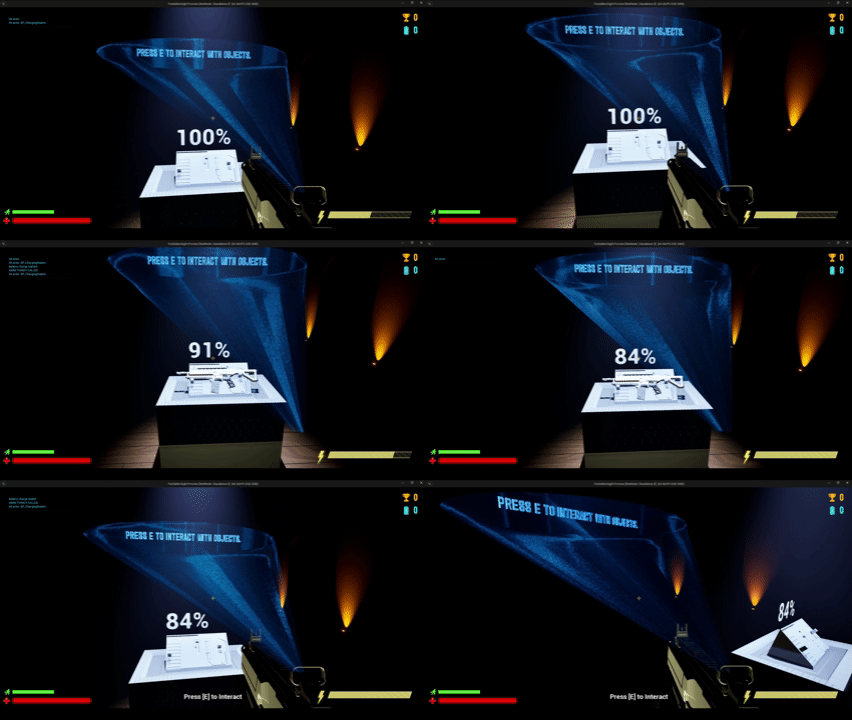
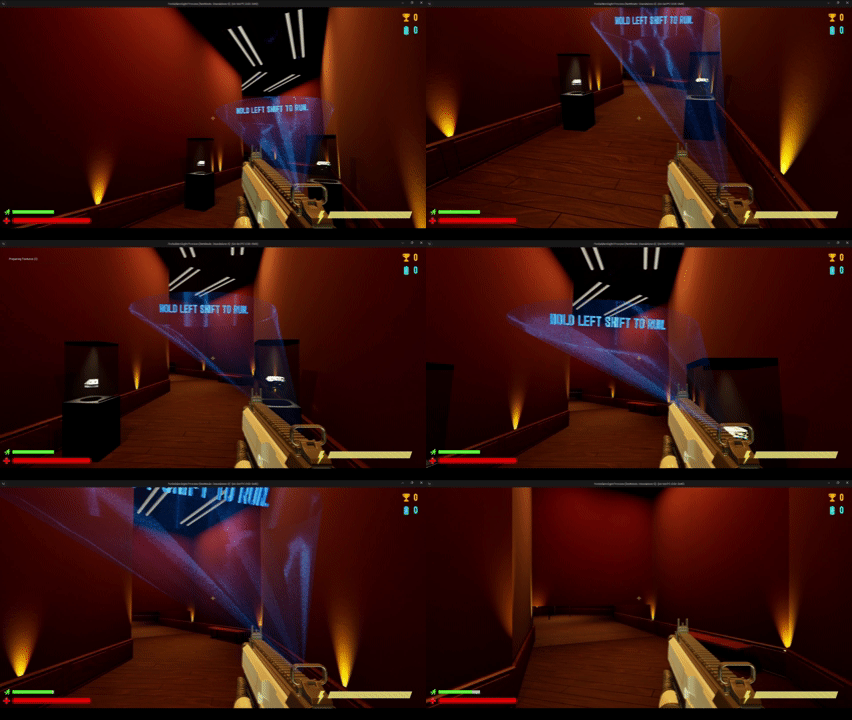
- I built a holographic text projector to match the narrative setting of the game, a future where players use an AI-equipped gun that can talk to players to tell them the manual.
- The holographic text projector shows text in the tutorial, telling players of procedures and puzzle mechanics while creating an illusion of holographic projection that dynamically reacts to player movement and location.
Malee
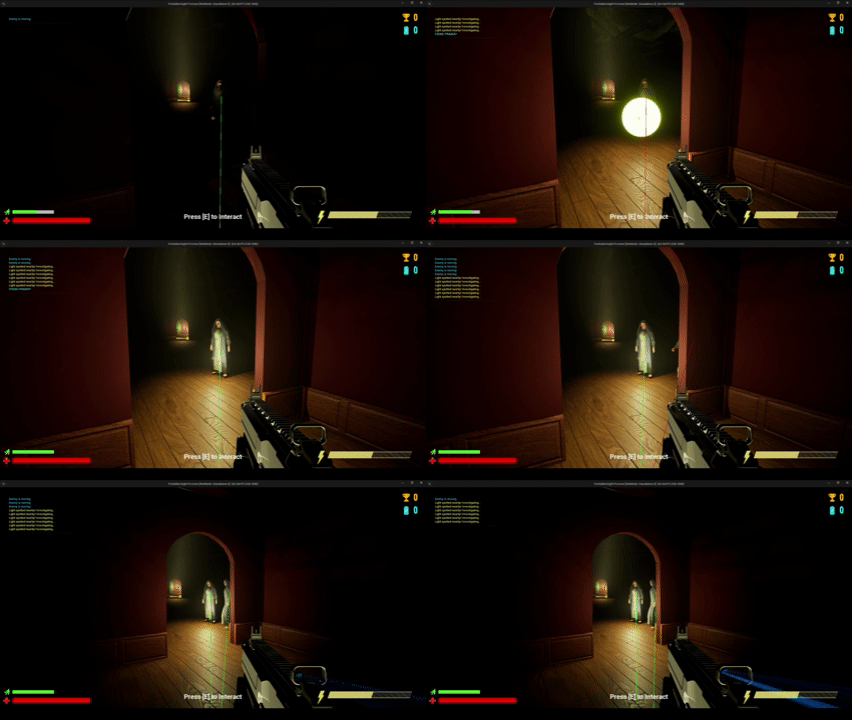
- The malee enemy has 2 states: Activated and Deactivated.
- Deactivated State: Enemy gets activated when they are inside the light trail.
- Activated State: Distinguishable by their red, glowing eyes, during the activated state, enemy patrols around itself and investigates an area if the player shoots near it. They also pursue 'visible' players who are in a line of sight to them and inside a light trail. Enemy will become deactivated once they are outside of the light trail and not aggravated for a certain amount of time.
Ranged (Not implemented)
- I designed enemy AI inspired by the “Weeping Angels” concept, where wax figure enemies slowly approach players when unnoticed. However, it felt overused to use the mechanic as it is.
- To make encounters more interactive and strategic, our enemies start deactivated and are become activated for a period of time when illuminated by the Light Illumination Gun, indicated by red, glow-in-the-dark eyes. Once activated, they pursue players who are in line of sight and inside the light trail left by the gun.
- To encourage stealth over combat, I plan to balance the AI by increasing enemy health and decreasing speed, creating tension while promoting strategic gameplay.
Utility (Not implemented)
- Players need to shoot the Light Illuminator Gun to explore the map and advance forward, but doing so puts them under risk of attracting enemies. To create a mechanic that counterbalances this, we added the second gun, the Gamma Gun.
- The Gamma Gun, which damages enemies and destroys light in its path, allows users to create a safe space after they have lit up the path to observe the area around them. We wanted to create the irony where players are safer when they are surrounded by the darkness.
Game Design Document & Core Gameplay Loop Diagram
I first drew a core gameplay loop visual as well as GDD for all the game mechanics.
Charging Station Iteration
- The first version of charging station didn't have a limited charge reserve.
- Through playtesting, we discovered that players could exploit it by shooting all around them next to the charging station, lighting up the whole section of the map, or camp next to it and kill all the enemies after luring them towards the station. These were unintended loopholes, so we created a limit on how much players can charge from a station.
Malee Enemy Behavior
- The first version of enemy had 2 behaviors: Chase player when it's inside the light trail, stop when it's outside.
- After playtesting, we wanted to add more complex behavior to them to make them feel smarter, which led to us adding an activated and deactivated states to it with line of sight to player as an additional enemy aggravation requirement.
Solving Player Skill Gap
- From playtesting, we received varying difficulty feedback between our players who had experience playing survivor horror/fps games and players who were relatively new to these genres. With resource management of the light gun charge being a huge part of our game, this posed a major balancing challenge as players with lower skill level would run out of light gun charges faster and get soft locked, leading to frustration without a mean to react to the environment.
- To solve this problem, we added an automatic light recharge mechanic, where the light charge of the gun slowly recovers over time. This mechanic gives players safety net when they run out of ammo, preventing them from getting soft locked behind any puzzles. It also creates a skill level differentiator as lower skill level players would take more time to clear the level if they rely on this mechanic, allowing players to compare clear time and speedrun the game.
- Finally, this mechanic would also improve the backtracking problem, which causes boredom when players have to constantly come back to the charging station to recharge their gun when they run out of charge. by providing this safety net mechanic, it encourages players to explore forward and take more risk in their gameplay.
Postmortem Presentation
Pitch Deck Used for Publishers
Reflection
What went well:
- My team was able to flexibly adapt to different directional changes and implement the feedback we received during throughout the development
- I was able to work on a lot of design tools for level designers, applying my programming skills as a technical designer
- I created a pipeline for system design and balancing using data tables, which made balancing and playtesting process in beta stage much more efficient
- I learned c++ in Unreal Engine during the project for the first time!
Obstacles:
- We had a lot of technical bottlenecks as it was our team's first time using metahuman and using them with a clothing designer. Our 3D artists had to prioritize figuring out the tools and pipelines, which made it hard to work on the visuals of the game.
- We didn't have a 2D artist or person for UI/UX, which became more work for the 3D artists.
- We had a few team members outside of the capstone class that wanted to stay in the team, and it was hard to expect the same level of commitment and communication to them as they were graduated.
Future Improvements:
- I would like to polish the balancing more and create formula for calculating the amount of charge required in the charging station using distance between charging stations.
- I would like to give more buffer to max gun charge to allow players to use up the charging station reserve on initial visit. This could further reduce the incentive of backtracking, a cause of boredom mentioned in playtests.
- I would like to redesign levels to be bigger, as it was a one of the reasons that made the exploration in the game scary in the prototype.